

 Send Email
 WhatsApp


What Food Processing Equipment Is Suitable for Vietnam Seafood Factories?
What Food Processing Equipment Is Suitable for Vietnam Seafood Factories?
Vietnam has become one of Asia's important seafood processing and export hubs, supported by strong aquaculture production, established processing capacity and extensive export connections.
The country's seafood industry is also moving toward higher-value products, greater processing efficiency and stronger traceability. According to the Vietnam Association of Seafood Exporters and Producers (VASEP), Vietnam's seafood exports reached approximately US$5.77 billion in the first half of 2026, up 12.7% year on year. Shrimp generated about US$2.35 billion, while pangasius reached approximately US$1.11 billion.
For seafood factories, this growth creates a practical equipment question:
What type of seafood processing equipment is suitable for a Vietnamese factory?
There is no single answer. A shrimp processor, a pangasius exporter and a tuna processor will require very different production systems.
The right equipment should be selected according to species, product format, production capacity, labor availability, yield, hygiene requirements, factory layout and export-market specifications.
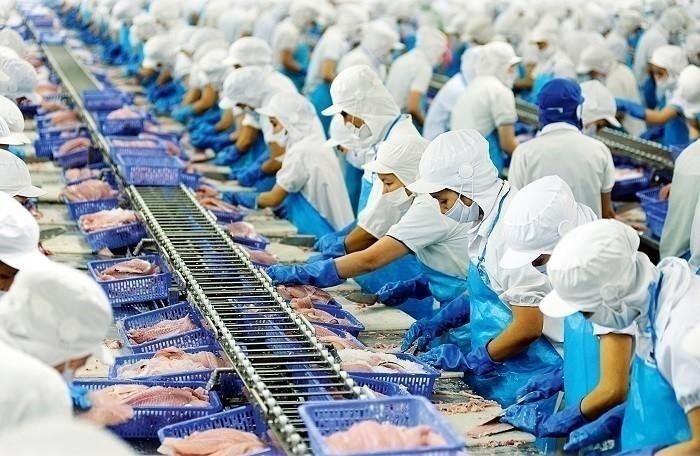
Real seafood-processing factory image from Vietnam. Source: ASEMConnect Vietnam. Use on the commercial website only after confirming image-use rights.
Vietnam Seafood Processing Is Moving Toward Higher-Value Production
Vietnam's seafood industry remains strongly export-oriented.
In 2025, seafood export turnover reached approximately US$11.3 billion, with VASEP noting an ongoing shift toward sustainability, transparency and higher-value products.
The trend has continued into 2026.
VASEP reported strong first-half growth in shrimp and pangasius, while also noting increasing opportunities for processed and value-added products. For pangasius, frozen fillets and portions under HS 0304 remained the largest product group, while value-added products were growing from a smaller base.
This matters for machinery buyers because factories increasingly need equipment that can support:
Higher throughput
Better product consistency
Improved yield
Reduced manual handling
More value-added processing
Export-quality hygiene and inspection
For this reason, equipment selection should begin with the product and production process rather than a machine catalogue.
1. Fish Filleting Equipment for Pangasius Processing
Pangasius is one of the most important seafood processing sectors in Vietnam.
VASEP reported that Vietnam's pangasius exports exceeded US$2.0 billion in 2025, and first-half 2026 exports reached approximately US$1.1 billion, up about 12% year on year.
For pangasius factories, fish filleting equipment is therefore one of the most relevant machinery categories.
A typical processing flow may include:
Fish Reception
→ Stunning / Handling
→ Scaling or Skin Preparation
→ Gutting
→ Heading
→ Filleting
→ Trimming
→ Washing
→ Grading
→ Weighing
→ Freezing
→ Glazing / Packaging
Depending on factory scale and product specification, individual stages can be manual, semi-automatic or automated.
A suitable fish Filleting Machine should be evaluated according to:
- Fish size range
- Raw fish condition
- Required fillet specification
- Filleting yield
- Production capacity
- Knife configuration
- Cleaning requirements
- Integration with downstream trimming
For Vietnam's export-oriented pangasius processors, yield is especially important. A machine that delivers high nominal capacity but causes excessive trimming loss may not provide the best economic result.
2. Shrimp Processing Equipment
Shrimp is currently the largest seafood export category in Vietnam.
VASEP reported shrimp exports of approximately US$2.35 billion in the first half of 2026, accounting for more than 40% of total seafood export value.
This makes shrimp-processing machinery another major opportunity.
A shrimp-processing line may include:
Receiving
→ Washing
→ Deheading
→ Peeling
→ Deveining
→ Grading
→ Inspection
→ Cooking or Freezing
→ Glazing
→ Packing
Different products may require different configurations.
For example:
Head-on Shrimp
Headless Shell-on Shrimp
Peeled and Deveined Shrimp
PTO Shrimp
Cooked Shrimp
Value-added Shrimp Products
Machines should therefore be selected around the final product specification rather than simply by raw shrimp throughput.

Real seafood-processing scenes from Vietnam showing shrimp/fish processing lines and manual inspection. Sources: TepBac, Thông Tin Đối Ngoại, ASEMConnect Vietnam. Confirm image licensing before commercial reuse.
3. Fish Scaling, Gutting and Cutting Machines
Not every seafood factory needs a fully automated filleting line.
Many processors handle multiple species, formats or production volumes.
In this situation, individual machines for:
Fish Scaling
Fish Gutting
Fish Head Cutting
Fish Cutting
Fish Skinning
can be practical.
These machines can reduce repetitive manual operations while allowing the factory to maintain flexibility.
This is particularly relevant for factories processing different fish sizes or supplying several product formats.
A modular approach can also make factory upgrades easier.
Instead of replacing the entire line, the processor can automate the most labor-intensive operation first and gradually connect additional equipment.
4. Conveyor and Material Handling Systems
Conveyors are easy to underestimate when planning seafood machinery.
However, poor material flow can create bottlenecks even when individual machines have sufficient capacity.
A seafood-processing factory may need conveyors between:
Receiving → Washing
Washing → Cutting
Filleting → Trimming
Trimming → Inspection
Inspection → Weighing
Weighing → Freezing
Freezing → Packaging
A well-designed conveyor system can reduce manual transportation, improve production flow and limit unnecessary product handling.
For export factories, equipment layout should also consider worker movement, hygiene zoning, cleaning access and separation of raw and processed products.
5. Washing and Cleaning Equipment
Seafood processing involves large volumes of water and raw material handling.
Industrial washing equipment can be used at different stages depending on the product and processing system.
Typical equipment includes:
Shrimp Washing Systems
Bubble Washers
Spray Washing Systems
Stainless Steel Cleaning Conveyors
The equipment should be evaluated not only by washing capacity but also by:
- Water consumption
- Cleaning effectiveness
- Product damage
- Hygiene
- Drainage
- Ease of sanitation
Efficient water and wastewater management is becoming increasingly important as seafood factories seek to control operating costs and meet environmental expectations.
6. Grading, Weighing and Sorting Equipment
As seafood products become more diversified, grading and weighing can become important control points.
For example, shrimp may need to be sorted by size.
Fish fillets may need to be grouped according to weight specifications.
Portion-controlled products may require automated weighing before packaging.
Equipment can include:
Automatic Graders
Checkweighers
Weight Sorting Systems
Vision Inspection
Electronic Scales
These systems can help improve consistency and reduce manual sorting.
For export-oriented processors, consistent product specifications are particularly important because retail and foodservice buyers may specify narrow weight or size ranges.
7. Inspection Equipment for Export-Oriented Factories
Vietnamese seafood exporters serve markets with increasingly demanding requirements related to food safety, traceability and compliance.
VASEP has highlighted the industry's need to respond to stricter environmental, traceability and social-responsibility requirements in international markets.
Depending on the factory's HACCP and product-control program, inspection equipment may include:
Metal Detectors
X-Ray Inspection
Checkweighers
Vision Inspection
Automatic Reject Systems
The appropriate technology depends on product characteristics and risk-control requirements.
For example, an inspection system may be installed after:
Filleting → Portioning → Freezing → Packaging
rather than as a completely separate process.
This is another reason seafood equipment should be designed as a production system, not simply purchased as individual machines.
8. Freezing and Glazing Equipment
For export seafood factories, freezing is often a critical part of the production chain.
Depending on the product, the factory may use:
IQF Freezer
Blast Freezer
Spiral Freezer
Plate Freezer
Glazing System
The correct choice depends on:
- Product type
- Product thickness
- Required freezing temperature
- Production capacity
- Freezing time
- Packaging format
- Cold-storage system
Pangasius fillets, shrimp and other seafood products can require very different freezing strategies.
For a high-volume factory, freezing capacity can become a major bottleneck if it is not properly matched with upstream processing.
A factory may therefore have excellent filleting capacity but still fail to achieve the desired daily output because the freezing section is undersized.
9. Packaging Equipment
The last stage of the process should also be considered when designing the production line.
Seafood packaging may include:
Vacuum Packaging
Thermoforming
Tray Sealing
Bagging
MAP Packaging
Weighing and Labeling
Packaging format depends on the target market.
For example, export products may be packed differently from foodservice products or retail-ready portions.
As a result, packaging should be specified together with:
Product Size + Weight + Freezing Method + Distribution Channel + Target Market
rather than as an isolated machine.
10. Should Vietnam Seafood Factories Choose Manual, Semi-Automatic or Fully Automatic Equipment?
There is no universal answer.
Manual Processing
Can remain practical for flexible production and operations involving multiple product formats, but requires more labor and can result in greater variation.
Semi-Automatic Processing
Can provide a useful balance for factories that need to reduce repetitive labor while maintaining flexibility.
Fully Automatic Processing
Can become more attractive for large-volume, standardized production with stable demand and a suitable factory layout.
VASEP reported in 2026 that industry events were showcasing advanced automation technologies for whiteleg shrimp and pangasius processing, including automated shrimp head-removal equipment and robotic pangasius gill-cutting technology, specifically to improve productivity, reduce dependence on manual labor and support evolving processing requirements.
This suggests that automation is becoming an increasingly relevant direction for Vietnamese seafood processors, but the appropriate automation level should still depend on the factory's actual economics and production model.
11. What Equipment Does a Medium-Sized Vietnam Seafood Factory Need?
A simplified modular configuration could look like:
Raw Material Handling
Receiving + Washing + Conveying
↓
Primary Processing
Scaling / Gutting / Heading
↓
Filleting / Peeling
Fish Filleting Machine
or
Shrimp Deheading + Peeling Machine
↓
Secondary Processing
Trimming + Cutting + Grading
↓
Quality Control
Inspection + Checkweighing
↓
Freezing
IQF / Blast / Other Freezing System
↓
Packaging
Vacuum / Thermoforming / Bagging
↓
Cold Storage
This type of modular configuration can be expanded according to production growth.
For example:
Stage 1: Individual machines
↓
Stage 2: Add conveyors and automated handling
↓
Stage 3: Add grading and inspection
↓
Stage 4: Integrate freezing and packaging
This approach can be particularly useful for existing factories that want to increase automation without replacing the entire plant.
12. How Should a Vietnam Seafood Factory Select Equipment Suppliers?
Equipment buyers should look beyond the initial machine quotation.
Important supplier-selection criteria include:
Production Capacity
Fish / Shrimp Size Range
Product Yield
Actual Reference Projects
Export Experience
Hygienic Design
Spare Parts Availability
Installation Support
Remote Technical Support
Lead Time
Electrical Compatibility
Future Upgrade Options
For international projects, after-sales service is especially important.
A factory in Vietnam may purchase equipment from China, Europe or another manufacturing region. The ability to obtain spare parts and technical assistance quickly can influence the real operating cost over the machine's service life.
This is why Foods-Land's supply-chain model focuses not only on individual equipment but also on equipment matching, supply coordination and long-term project support.
Vietnam Seafood Processing: Where Are the Biggest Equipment Opportunities?
Based on current export structure and industry development, several equipment categories are particularly relevant to Vietnam:
1. Shrimp Processing Equipment
High-value opportunity because shrimp remains Vietnam's leading export category.
2. Pangasius Processing Equipment
Especially:
Fish Filleting
Trimming
Cutting
Grading
Portioning
Pangasius remains one of Vietnam's largest seafood export sectors.
3. Processing Automation
Especially where repetitive manual operations are limiting productivity.
4. Inspection and Quality Control
Increasingly important for export-oriented production and traceability requirements.
5. Freezing and Packaging
Critical for higher-value export products and retail-ready formats.
6. Modular Factory Upgrades
A significant opportunity for existing factories that need higher productivity without completely rebuilding their production plants.
The Future of Vietnam Seafood Processing: From Processing Capacity to Production Intelligence
Vietnam's seafood industry is not simply trying to process more raw material.
The longer-term opportunity is to produce higher-value products with greater consistency and better resource efficiency.
That means equipment selection will increasingly involve:
Automation
Yield Optimization
Digital Monitoring
Inspection
Traceability
Energy Efficiency
Water Efficiency
Flexible Production
Value-Added Processing
VASEP's 2026 industry reporting points toward deeper processing and more value-added seafood products as an important avenue for future development. For pangasius, the association specifically highlighted the need to increase investment in deep processing and product diversification.
For machinery suppliers, this means the opportunity is moving beyond:
toward:
“seafood processing solution for a specific product, capacity and factory.”
Final Thoughts
The right seafood processing equipment for a Vietnam factory depends on four fundamental questions:
What species are you processing?
What finished product are you selling?
What capacity do you need?
How much automation does your factory actually require?
For a pangasius processor, fish filleting, trimming, grading, freezing and packaging may form the core equipment chain.
For a shrimp processor, deheading, peeling, grading, washing, freezing and packaging may be more important.
For a multi-species seafood factory, modular equipment can provide the flexibility to process different products while gradually reducing manual operations.
The most effective solution is therefore not necessarily the most automated or the most expensive system.
It is the system that provides the right balance between:
Capacity + Yield + Labor + Hygiene + Flexibility + Investment + Future Expansion
Build Your Vietnam Seafood Processing Solution With Foods-Land
Foods-Land connects international food manufacturers with seafood processing equipment and production solutions, including:
Fish Filleting
Fish Cutting
Fish Scaling
Shrimp Deheading
Shrimp Peeling
Fish / Shrimp Washing
Grading
Inspection
Freezing
Packaging
For a new seafood factory or an existing production-line upgrade, tell us your seafood product, target capacity, factory location and current processing method.
Foods-Land can help evaluate suitable equipment configurations for your Vietnam seafood processing project.